Redefining Technical Debt: A Guide to Prioritizing Tasks with Customer Value in Mind

Anybody who’s worked in software engineering – be that as an engineer, program manager, designer, or any one of the numerous other roles essential to the delivery of quality software – will be well aware of the term “technical debt”.

Photo by Jason Goodman on Unsplash

At its most simple level, Technical debt is a technical task that was omitted earlier in the project (often to meet a tight deadline) that requires repaying (ie. It still needs to be done). The challenge comes from its nature as a “technical” task – that is, it is most easily attributed to bringing value to the code, or technical team, than it is to the customer.

This tension can often make tech debt tasks hard to prioritise – if you’ve been involved in planning or the management of software engineers how many ties have you heard a complaint to the effect of “I can never get the technical debt prioritised, the business only cares about new features”?

I’ve worked on different teams, on different projects, and at different companies, during which I’ve formed a few opinions on how tech debit is best managed and prioritised, which I think can help teams be most productive.

Before you read any further, I should make clear, that I don’t believe that the “most productive” teams, (that work harmoniously and resolve this tension) manage this by just fixing all of the tech debt. Nor do I think everybody is necessary happy with the outcomes. They key thing is that all parties involved have made a conscious and deliberate decision that they should or should not work on a particular task at a particular time.

There have been several methods used in teams to try and manage this balance – one such technique is reserved time – ring fencing x% of a team’s capacity for tech debt tasks. There are places and times where this works great, but I don’t think it a solution that considers all of the angles.

Continue reading

Internet of Poop: How (and Why) I Built a Smart Litter Tray

Naturally, we want our pets to be as healthy and happy as possible, and just as with humans, one valuable metric to know is their weight. Knowing the weight of our four-legged friends, not only helps us to verify that they have a healthy amount of body fat, but can also can be used to detect things early on that may need medical attention. As they cannot speak to us and tell us when don’t feel well, it is our duty to listen to all of the different signals we have to understand their wellbeing.

Photo of a black shorthair cat sitting.

That’s why I wanted to know the weight of my cat, Ellie. Unfortunately, she really dislikes being picked up or handled, even by people she trusts. This means, it’s not possible to weigh her on a bathroom scale, and the only datapoint I have is her yearly examination at the vets. 

I wanted to build something that would fit into her life to track her weight automatically, without any intervention. I decided to modify her litter box, so that on each visit it records her weight.

But WHY, Andy?

Okay I get it; you think it’s weird. So here are the main goals of the project: 

  • Track Ellie’s weight because I want to know how heavy she is without going to the vet
  • Learn something about how load cells work
  • Have fun building a new project
  • (Hopefully) Inspire others to try out new ideas and projects by sharing what I learned. 
  • Track the weight of poops because I thought that was funny. 

The Hardware

Rather than build the whole litter tray from scratch, I decided to build a platform that her existing litter tray would rest on. This platform would contain all the equipment necessary to detect when Ellie was using the litter and start taking measurements.

Continue reading

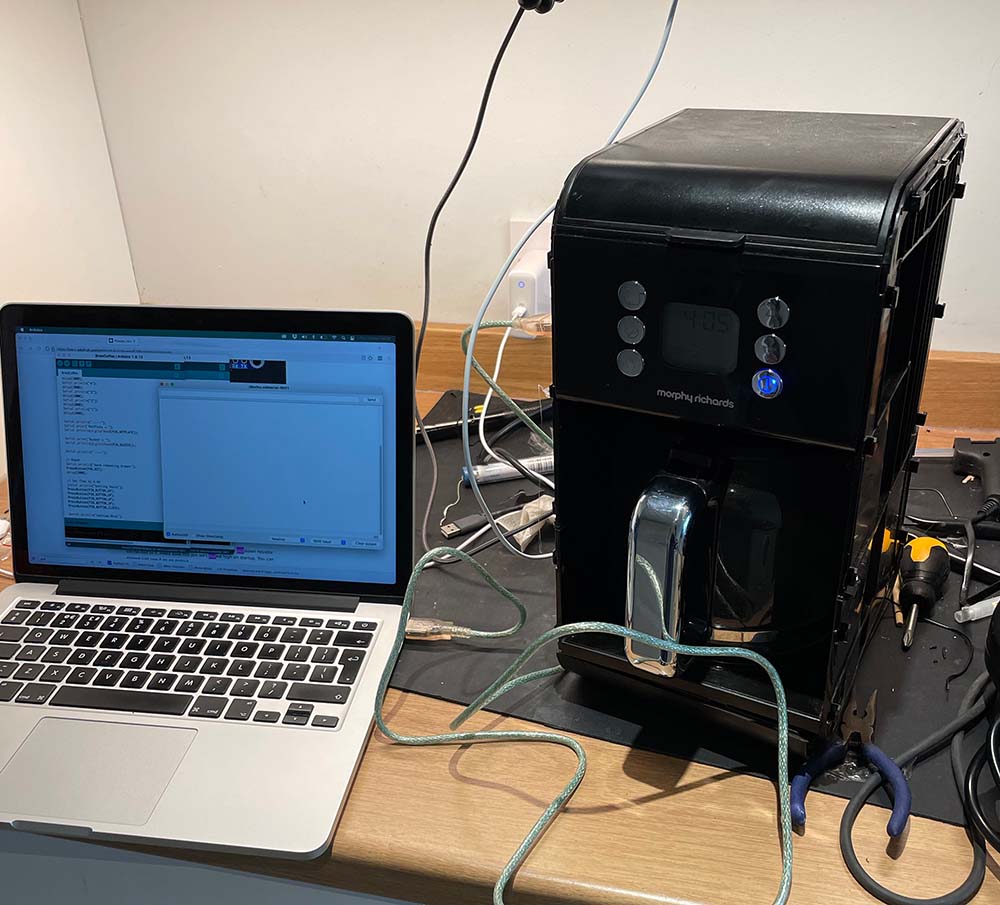
How I Hacked My Coffee Machine To Be Smart

Before the pandemic, when we started working from home, I used to make coffee a number of different ways, depending how I felt. I liked to experiment – sometimes I would use a V60, others a French Press, coffee syphon or espresso machine. This worked well on the weekends when I had time to experiment a little. However, when you need to grab a quick coffee between meetings, it turned into a real faff; there’s just no matching the convenience (if not the quality) of the office coffee machine.

My solution here was to pick up a Morphy Richards Verve filter coffee maker that I could leave running while I went about my work and come back to when it was done. I was really surprised with this machine, I was expecting to sacrifice a lot of quality for convenience, but with a little fine tuning on ground size and water quantity, its capable of producing some very drinkable coffee.  

Occasionally, though, I would get it brewing and forget to go back to collect the drink, leaving it going stale on the hot plate so I decided to see if I could connect it to my network for notifications and control.

My requirements were:

Continue reading